Daily from 8:00 AM to 6:00 PM
Certified Coverage: Riyadh • Jeddah • Eastern • Makkah • Qassim
Do not let progressive masonry fractures, column spalling, and sub-slab subsidence endanger structural stability and compound repair expenditures. At Manzel El Deqa, we deliver scientific on-site diagnostics utilizing ultrasonic sensors and laser profiling, executing code-certified remedies under the Saudi Building Code (SBC) backed by official written warranties up to 10 years.
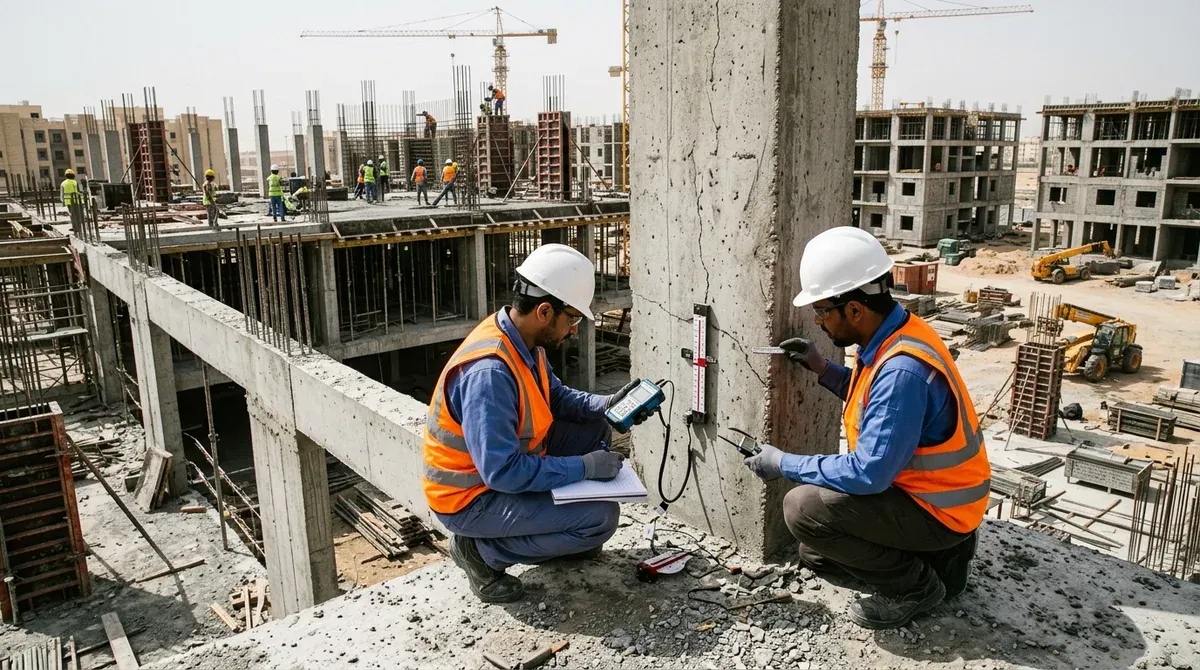
Advanced sensor testing & formal structural safety reports
Pinpointing the root structural cause of cracking or corrosion before commencing remediation.
Utilizing certified polymer-modified mortars, structural epoxies, and aerospace-grade carbon fiber.
Itemized breakdown of all execution steps and material bill of quantities with zero hidden costs.
Specialized technical crews supervised by senior structural engineers ensuring SBC compliance.
Soil mechanics and climate factors differ significantly between coastal humidity in Jeddah and expansive soils in Riyadh. Select your city to view the most requested engineering solutions.
Treating rebar rust and concrete spalling caused by marine humidity and Red Sea salts.
Advanced water barriers for roofs and underground tanks resisting saline water tables.
Restoring moisture-eroded facades, modernizing plumbing, and structural strengthening.
Acoustic and thermal scanning of concealed water lines and cisterns to reduce bills.
Structural epoxy injection and mechanical stitching preventing recurrent movement.
Stabilizing soft coastal subgrade and raising courtyard slabs without demolition.
Laser-guided raising of settled villa driveways with expanding polymer, zero tile damage.
Treating 45-degree diagonal shear cracks caused by foundation subsidence and clay drying.
Dual water and thermal insulation shielding upper floors from extreme summer heat.
Securing deep foundation pits and rocky cuts to protect adjoining buildings from collapse.
Self-leveling heavy-duty epoxy coatings resisting forklift wear and motor oil staining.
Repairing casting honeycombs and column strengthening with high-tensile CFRP carbon fiber.
Take a photo of the cracks, spalling, or leak, and send it via WhatsApp. We will help diagnose the condition and recommend the appropriate service.
We provide specialized structural interventions originating from precise root-cause diagnostics, utilizing certified polymers and advanced civil engineering standards.
Specialized engineering solutions to rehabilitate deteriorating concrete elements, treat rebar corrosion, and repair spalling using certified polymer mortars and high-tensile carbon fiber.
Advanced engineering methods to correct footing settlement and subsurface ground voids via expansive polymer resins and cementitious pressure grouting without breaking floors.
Advanced protective waterproofing systems for exposed roofs, subterranean tanks, and basements, preventing water infiltration, thermal heat gain, and structural decay.
Engineering diagnosis and classification of wall and structural cracks, followed by low-viscosity epoxy pressure injection or carbon fiber stitching to permanently arrest propagation.
Application of seamless, high-durability epoxy and polyurethane floor systems for parking lots, commercial warehouses, factories, and pharmaceutical facilities.
The difference between certified structural rehabilitation and superficial patching lies in diagnostic precision. We follow a strict scientific protocol that protects building longevity and asset value.
Deploying digital moisture sensors, Schmidt test hammers for concrete surface hardness, and acoustic leak detectors to profile hidden internal anomalies.
Strict distinction between symptoms and structural drivers: whether the fracture stems from foundation subsidence, rebar oxidation, or thermal stresses, ensuring direct targeted intervention.
Structuring intervention plans and BOQs under SBC 304 (Concrete Structures) and SBC 303 (Soils & Foundations) ensuring municipal approval and structural safety.
Controlled mechanical chipping, V-grooving along fractures, sandblasting to Sa 2.5 white metal, and dust extraction ensuring maximum mechanical adhesion for new polymer matrices.
Deploying high-modulus epoxies, expanding polyurethanes, and CFRP carbon fibers from world leaders (Sika, BASF, Fosroc) adhering to strict stoichiometric mix ratios and cure cycles.
Executing post-treatment verification (hydrostatic water flooding for waterproofing, laser flatness scanning for lifted slabs) and delivering certified reports with official warranties.
Structured, transparent milestones providing complete peace of mind from your first call to final warranty certification.
Call our hotline or submit defect photos via WhatsApp to schedule an on-site visit by a licensed civil engineer within 24 to 48 hours.
Thorough site assessment using testing instruments, root-cause identification, and delivery of a clear engineering report with an itemized BOQ.
Mobilizing specialized equipment and certified materials under continuous on-site structural engineering supervision and safety protocols.
Conducting engineering validation tests to confirm total defect elimination, followed by delivering the final dossier and official written warranty.
Confusing defect classifications leads either to wasted expenditure on unnecessary works or, far more dangerous, allowing critical structural shear failures to progress toward partial collapse. Here is our scientific differentiation:
Plastic Shrinkage & Thermal Checks (Hairline): Fine surface checks rarely exceeding plaster depth with widths below 0.3mm, treated easily with elastomeric coatings. Conversely, Structural Settlement Cracks: Diagonal 45-degree through-wall fissures or beam shear fractures demanding immediate shoring, foundation soil stabilization, and high-tensile CFRP carbon fiber encapsulation.
Structural Epoxy Injection: High-modulus rigid resin exceeding 50 MPa bond strength deployed on dry structural fractures to restore monolithic continuity. Polyurethane (PU) Injection: Hydrophobic foam expanding up to 20x upon contact with water, engineered specifically to halt running groundwater leaks in basements and seal dynamic expansion joints.
Carbonation occurs when atmospheric carbon dioxide diffuses into concrete, reacting with calcium hydroxide to drop the pH from 12.5 to below 9. This destroys the steel's passive protective layer, initiating laminated rust that expands up to 6 times original volume, exerting massive internal tensile forces that shatter concrete from the inside out.
CFRP sheets and plates provide an extraordinary 3000 MPa tensile capacity at a thickness under 1.5mm. This composite technology surpasses heavy concrete jacketing because it requires zero footing enlargement, eliminates dead weight additions, preserves parking stall clearances, and installs with exceptional speed.
Match the visible defect in your property with our technical diagnostic table to identify the designated engineering solution.
| Visible Defect in Building | Probable Engineering Diagnosis | Recommended Service | Action |
|---|---|---|---|
| Spalling concrete chunks exposing rusty brown corroded steel in ceilings or columns | Advanced rebar corrosion and concrete carbonation | Concrete Repair & Rehabilitation | Inspect |
| Sinking courtyard slabs, detached tiles, or subterranean air voids under entrances | Subgrade washout or poorly compacted backfill beneath slab | Soil Injection & Stabilization | Inspect |
| 45° diagonal cracks around doors/windows and through-block fractures | Shear stress or differential foundation settlement along an axis | Wall Crack Epoxy Repair | Inspect |
| Rainwater dripping from ceiling or chronic underground tank water loss | Waterproofing membrane failure or cracking in tank construction joints | Waterproofing & Thermal Insulation | Inspect |
| Paint peeling up to 1 meter high with salt efflorescence along baseboards | Rising dampness through capillary suction from unsealed subbase | Concrete Restoration & Moisture Barrier | Inspect |
| Warehouse or garage concrete floor dusting, spalling, and generating constant grit | Surface mechanical wear and lack of abrasion-resistant topcoat | Industrial Epoxy Flooring | Inspect |
Real case studies from our projects illustrating initial structural deterioration and measured outcomes following certified rehabilitation protocols.
30mm loss of concrete cover exposing primary vertical rebar coated with heavy exfoliating rust and an estimated 15% effective cross-section loss, threatening upper beam stability.
Temporary shoring with hydraulic jacks, rebar wire descaling, zinc phosphate epoxy primer, recasting with non-shrink high-strength polymer mortar, and 2-layer CFRP wrapping restoring 180% capacity.
Severe differential settlement triggered by subterranean pipe leak washout, creating deep voids up to 1.5m and wide floor fissures that halted forklift logistics.
Injecting high-density expanding polyurethane through 16mm micro-ports; expanding to fill all voids and generating controlled hydraulic lift that returned the slab to design datum within 48 hours without business shutdown.
Wide longitudinal cracks in 4 primary ground-floor columns with concrete cover spalling and advanced rebar corrosion caused by the aggressive coastal marine environment.
Ceiling shoring with hydraulic props, mechanical rebar descaling and zinc-rich epoxy anti-rust coating, supplemental stirrups and rebar placement, recasting with non-shrink polymer mortar, and CFRP carbon fiber jacket wrapping.
100% restoration of design structural load capacity with verified protection against marine salts and humidity for years to come, completely avoiding column demolition.
Differential settlement across 450 sq.m of warehouse slab creating deep subsurface voids and widening expansion joints triggered by an underground water pipe leak.
High-density expanding polyurethane resin injection through 16mm micro-ports to compact subgrade, fill underground cavities, and generate controlled hydraulic lift restoring slab elevation.
Complete subgrade void closure, permanent soil stabilization, and restored floor flatness with zero business interruption and no concrete slab demolition.
Heavily fractured rock face immediately adjoining residential foundation excavation, presenting an imminent rockfall hazard during site construction and seasonal rainstorms.
Installation of 3-meter galvanized rock bolts, heavy-duty wire mesh, high-pressure application of 120mm dual-layer shotcrete, and perforated groundwater weep holes.
Complete slope stabilization, total protection for neighboring buildings, and verified engineering signoff from municipal supervising authorities.
Building deterioration mechanisms vary sharply based on regional geology and weather. Our hands-on field experience across 11 cities enables us to calibrate the exact remedy for each local environment:
Structures in Jeddah suffer from high humidity and airborne marine chloride salt spray accelerating rebar corrosion. In Makkah and Taif, shallow groundwater dynamics and steep granite slopes require shotcrete slope stabilization, rock bolts, and deep crack injection.
The arid desert climate imposes severe summer-to-winter temperature differentials (differences up to 35°C), generating intense thermal expansion and contraction stresses that fissure roofs and walls. Expansive clay soils frequently provoke courtyard slab settlement.
High-salinity groundwater tables and sabkha soil rich in aggressive sulfate and chloride ions attack foundation concrete and underground water tanks, requiring heavy polymer barrier systems and subgrade stabilization against hydraulic erosion.
We build client trust across Saudi Arabia on transparent engineering data and certified results, avoiding empty marketing claims.
Strict adherence to SBC 304 (Concrete Structures) and SBC 303 (Soils & Foundations), ensuring full structural integrity and approval by engineering consulting offices.
Exhaustive logging of all intervention stages with photo, video, and non-destructive sensor metrics before, during, and after completion, presented in a formal handover dossier.
Exclusive sourcing of original structural formulations from top-tier international chemical manufacturers with ASTM & ISO certifications, eliminating substandard mixes.
Binding legal contracts specifying scope, BOQs, technical specifications, and project milestones, coupled with certified written warranties up to 10 years upon successful handover.
Learn the critical engineering differences between harmless surface plaster shrinkage checks and dangerous structural foundation shear cracks, and when urgent intervention is necessary.
An engineering study on how airborne chloride ions and saline groundwater in cities like Jeddah and Dammam penetrate reinforced concrete, and certified methods for lasting protection.
Why do villa courtyard slabs and driveways settle? Discover how expanding polyurethane polymer soil injection restores slab levels and stabilizes ground without messy excavation.
Comprehensive engineering answers from our licensed staff regarding inspection criteria, remediation mechanisms, and certified warranties across 11 cities.
Dangerous structural cracks typically penetrate the full thickness of the wall and frequently manifest at a 45-degree diagonal radiating from the corners of door lintels and window frames, or as continuous horizontal fissures along reinforced concrete beams. Furthermore, crack apertures exceeding 2mm, active progressive widening over time, or accompanying operational resistance when opening and closing doors and windows signify differential foundation settlement requiring immediate structural engineering evaluation.
Engineering remediation follows strict sequential phases: First, temporary structural load relief using hydraulic jacks and certified shoring towers where required. Second, careful mechanical chipping around corroded rebar to a clearance of at least 20mm behind the bar. Third, abrasive blasting or wire mechanical cleaning to bare white metal (Sa 2.5), followed by immediate application of a zinc-rich epoxy anti-rust primer for cathodic protection. Fourth, if rebar section loss exceeds 20%, supplemental bars are chemically anchored. Finally, the structural cross-section is rebuilt using non-shrink polymer-modified mortar and reinforced with CFRP carbon fiber jackets where design calculations require.
No. Modern geotechnical expansive polymer injection is entirely non-invasive. Tiny coin-sized micro-ports (only 12 to 16mm in diameter) are drilled through tile grout joints or perimeter slab edges without shattering tiles or removing floor finishes. High-density expansive polymer resins are injected under regulated pressure, expanding with controlled hydraulic lift to fill deep cavities, densify loose strata, and re-level settled slabs under real-time laser monitoring without facility shutdown.
Structural epoxy injection is formulated for dry structural fissures. Cured epoxy yields mechanical tensile and compressive bond strengths exceeding 50 MPa—higher than the surrounding parent concrete—monolithically restoring structural load continuity. Conversely, polyurethane injection is engineered for water-bearing or moving dynamic joints. Polyurethane reacts instantly upon contact with water, expanding up to 20 times its volume to form a resilient, flexible elastomeric seal that halts running leaks in basements and underground water tanks.
We guarantee waterproofing performance by combining thorough mechanical surface preparation (treating honeycombing, rounding all 90-degree internal floor-wall coves with polymer fillets) with certified, multi-layer polyurethane or elastomeric acrylic waterproofing systems. Furthermore, no project is formally signed off without a mandatory continuous 48-to-72-hour hydrostatic flood test, followed by the delivery of an official written warranty certificate.
Yes. Carbon Fiber Reinforced Polymer (CFRP) wraps and laminates represent an advanced engineering alternative to heavy concrete jackets. CFRP delivers tensile strengths 7 to 10 times higher than structural steel with negligible dead weight. With a total thickness of only 1.2 to 3mm, CFRP preserves architectural room dimensions and parking stall clearances without demanding foundation enlargement, and installs in a fraction of traditional construction time.
The process begins when you contact us via phone, WhatsApp, or our online quote form. We schedule a licensed site engineer visit within 24 to 48 hours. The engineer executes non-destructive testing (moisture profiling, Schmidt hammer hardness, crack depth gauging) and issues a formal engineering diagnostic report with an itemized BOQ. Following client approval and contract signing, specialized mobilization teams deploy immediately according to an agreed timeline.
We maintain field presence across 11 key cities and governorates: Riyadh, Jeddah, Makkah, Taif, Dammam, Khobar, Al-Ahsa, Jubail, Qatif, Qassim, and Jumum. Our establishment deploys self-contained mobile injection rigs, shotcrete pumps, and testing diagnostic vans ready to handle residential, commercial, and industrial facilities with consistent speed and engineering rigor.
Submit your property details and defect nature. A licensed civil engineer will contact you to schedule an on-site visit with diagnostic equipment.
All submitted data is kept strictly confidential and reviewed by Manzel El Deqa engineering staff.
Our civil engineers are on standby to answer your questions and deliver an immediate preliminary assessment of crack or concrete corrosion severity.