Daily from 8:00 AM to 6:00 PM
Certified Coverage: Riyadh • Jeddah • Eastern • Makkah • Qassim
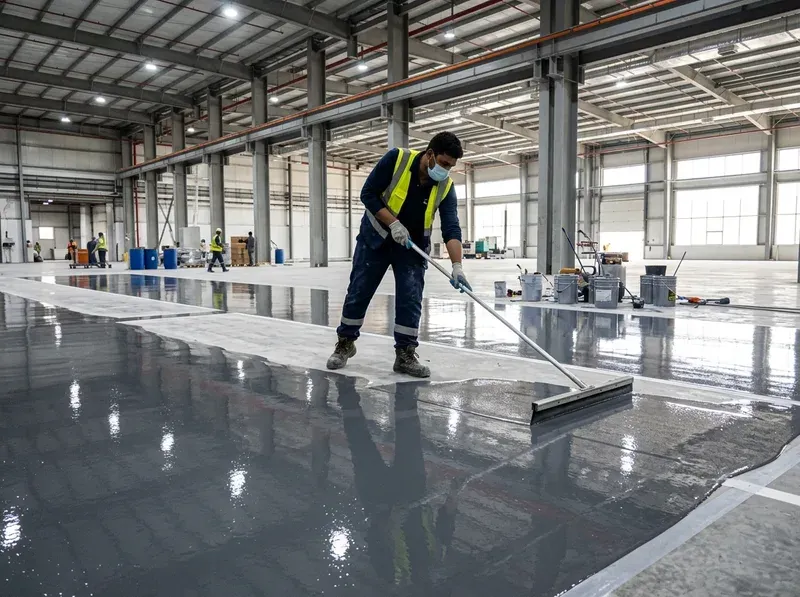
We engineer seamless, chemical-resistant, tire-abrasion-proof flooring solutions with custom striping and safety markings conforming to international industrial standards.
Pinpointing the root structural cause of cracking or corrosion before commencing remediation.
Utilizing certified polymer-modified mortars, structural epoxies, and aerospace-grade carbon fiber.
Itemized breakdown of all execution steps and material bill of quantities with zero hidden costs.
Specialized technical crews supervised by senior structural engineers ensuring SBC compliance.
In Saudi Arabia's challenging climatic and geotechnical environment—ranging from saline high-humidity coastal zones in Jeddah, Dammam, and Khobar to severe thermal contraction and subterranean water dynamics in Riyadh and Makkah—structural defects require scientific intervention rather than superficial cosmetic covering.
We engineer seamless, chemical-resistant, tire-abrasion-proof flooring solutions with custom striping and safety markings conforming to international industrial standards. We identify the driving chemical and mechanical catalysts behind defects to prevent recurrent failures, protect structural integrity, and ensure complete compliance with the Saudi Building Code (SBC).
Early detection prevents progressive structural degradation and saves tens of thousands in extensive demolition. Inspect your property for these critical warning indicators:
Persistent concrete dusting damaging delicate inventory, machinery, and parked automobiles.
Deep oil, coolant, and chemical stains penetrating untreated concrete that resist standard detergents.
Pitted, rutted concrete surfaces resulting from aggressive forklift traffic and heavy vehicle impact.
Regulatory need for sanitary, easily sterilizable, seamless surfaces in pharmaceutical and food facilities.
Our engineering execution adheres strictly to documented quality benchmarks and laboratory testing stages:
Checking slab relative humidity, mechanical diamond grinding, and HEPA industrial dust collection.
Filling spalls and surface voids with high-compressive epoxy mortar to achieve absolute flatness.
Saturating concrete matrix with solvent-free primer to lock out air pinholes and maximize bond.
Spreading epoxy resin to required design thickness (1mm to 3mm) and rolling with spiked rollers to de-aerate.
Painting directional arrows and safety zones, followed by aliphatic polyurethane UV scratch-resistant topcoats.
We exclusively deploy code-certified chemical composites, structural polymers, and engineered resins proven to withstand severe environmental exposure:
Every facility presents distinct physical conditions. Pricing is transparently structured around verified engineering metrics:
Masking active fractures or rebar oxidation under putty or paint traps moisture inside, accelerating structural loss until sudden catastrophic failure occurs.
Standard Portland cement shrinks substantially upon hydration, forming micro-gaps that invite oxygen and water to resume degradation beneath the repair patch.
Addressing structural and geotechnical defects within the first month costs up to 75% less than waiting until foundation settlement or rebar section loss requires heavy shoring and carbon fiber encapsulation.
Book an inspection appointment with our structural engineering team to receive an exact diagnosis and certified estimate.
Direct engineering answers concerning technical specifications, material chemistry, and execution timeframes.
Light foot traffic is permitted within 24-48 hours. However, full chemical curing requires 5 to 7 days before exposing the floor to heavy forklifts, delivery trucks, or standing water.
Our engineering inspection teams for Industrial Epoxy Flooring cover properties and projects across the following cities and regions:
Do not allow structural deterioration to escalate. Our engineering team is ready to inspect, assess, and deliver certified reports and BOQs.